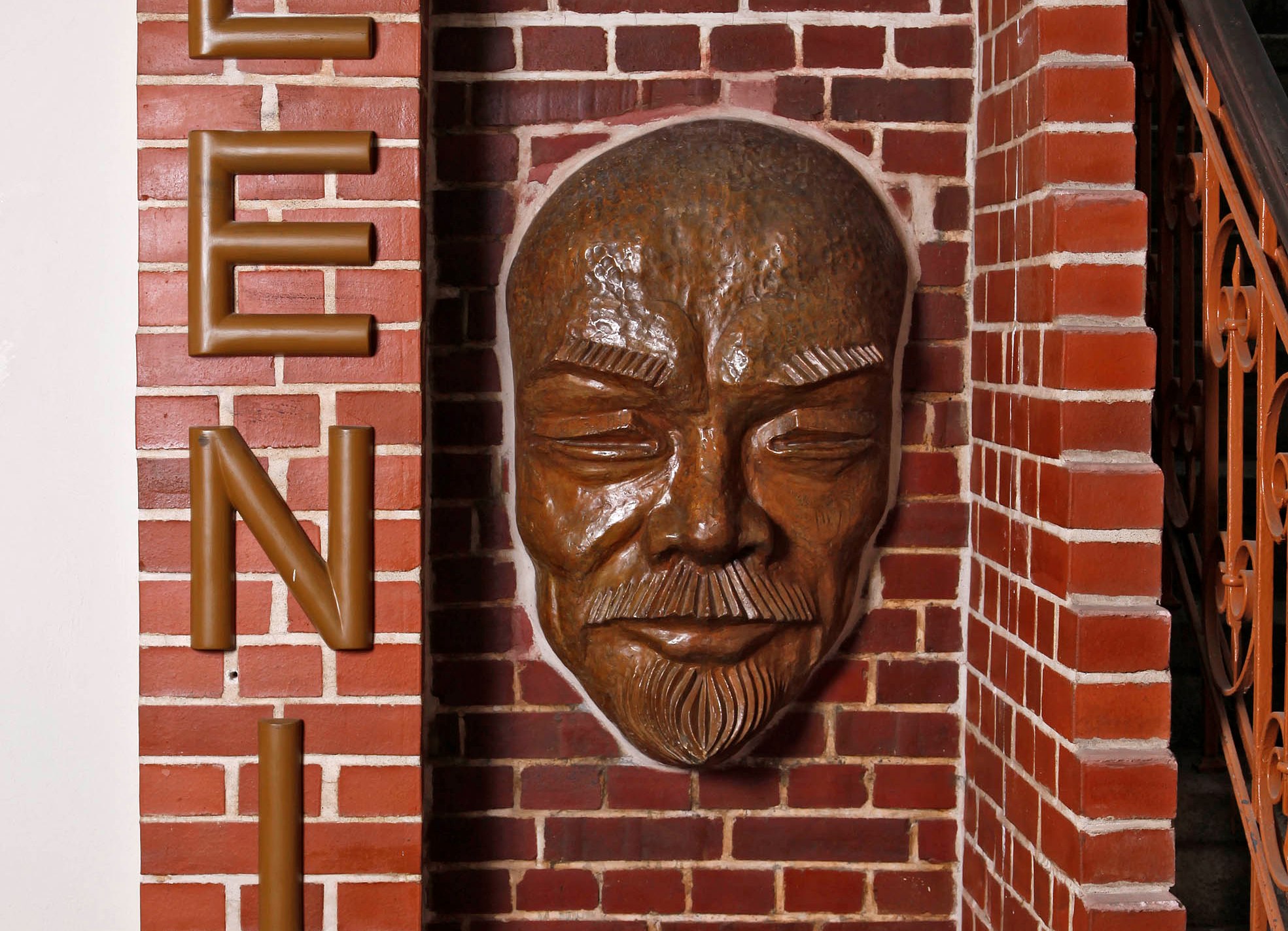
The first Lenin monument in Germany was inaugurated in 1929 and placed in the building of the German Communist Party (KPD) in Halle. After a trip to the Soviet Union, a group of members of the KPD described with enthusiasm the “Lenin corners”, which could be seen all around the country. These memorials consisted of a representation of Lenin and other Communist symbols, located in buildings of the public administration or political organizations. Following this model, the KPD of Halle-Merseburg decided to erect the first German monument dedicated to Lenin. The central element of this installation was a ceramic mask 1,10m in height and 80cm in width, made by the sculptor Will Halle. Weiterlesen
Schlagwort: Communism
Residents save Lenin-monument
In the small city of Bützow in the federal state of Mecklenburg-Vorpommern there is still a street named “Leninring”, where a commemorative stone dedicated to the founder of the Soviet Union can be found. The monument stands in front of an apartment block with the typical Socialist architecture style and is in bad shape, partially overgrown with moss. But nevertheless the Communist revolutionary still seems to matter to the residents, who in the year 2011 rebelled against a proposal of the local CDU, to change the name of the street (which would also have meant the demolition of the memorial stone). Weiterlesen
The light box
The Soviet Officer’s House in Weimar was built in 1974 for the higher commanders of the 8th Guards Unit. It was used as a cultural center, meeting place and restaurant. Two monuments dedicated to Lenin were erected in this complex: a bust made of bronze and a stained light box. Weiterlesen
X-files: Lenin in Potsdam 1 – The Statue
A statue, which is under monument protection, but disappears without a trace. An old and forgotten bust, which suddenly is standing at the entrance of the Volkspark. Lenin’s existence in Potsdam is a succession of mysterious incidents and even journalists, politicians and public authorities lose track of it. Weiterlesen
At the border
In April 2016 a bust of Lenin was erected only a few meters from the border between Germany and Poland. During World War II, this sculpture had been stolen by the German army in the Soviet Union and sent to Küstrin-Kietz, in order to be destroyed and reused as a raw material for the arms industry. But two workers of the scrapping facility decided to hide it, saving it from the imminent smelting. Weiterlesen
Damnatio memoriae (ENG)
The abandoned military area of Wittstock has turned into a ghost town. Entire apartment buildings, schools, office-blocks and hangars are falling apart. In front of the former cultural center we find an image, which is rich in contrasts: Lenin is standing there with his typical statesmanlike pose, but he is mutilated and completely covered with lichen. It was not possible to get more information about this act of vandalism, but the view of this half-destroyed statue seems like an exemplary representation of the neglect of the East-German monumental landscape. Weiterlesen
In the shadow of the Berlin Wall
The relaxed Lenin
Near the Saxon city of Riesa, where one of the last statues of Lenin is still standing in a public square, there is another, rather unknown sculpture of the Soviet revolutionary. It’s standing in the restricted area of the former military area of Zeithain, which is now open to public. Weiterlesen
In the heart of capitalism
It may sound bizarre, but in Frankfurt, the European financial center, one can find a monument dedicated to Lenin. In front of the private museum Explora there is a bust of Lenin, which was rescued from a scrap yard and tuned by the artist M. Charlamov, who added 3D-glasses to the sculpture and called it Anaglyphowitsch. Weiterlesen
Lenin in Switzerland
During his last month of exile before travelling back to Russia, where he would lead the October Revolution, Lenin lived in Zürich. He spent most of his time in libraries, working on his political texts, or in cafés, where he often met other Russians living in exile. On the weekends, he liked to go with his wife, Nadeschda Krupskaja, to the Zürichberg, a green hill nearby. It was in that moment when Lenin wrote his essay “Imperialism, the Highest Stage of Capitalism”, one of his most important works. Weiterlesen