Besides the window pane in the Faculty of Law, in the Humboldt University we can still find another representation of Lenin. It is part of the triptych of leaded windows made by the Socialist artist Walter Womacka in 1962 placed at the central university building in Dorotheenstraße. Weiterlesen
Schlagwort: GDR
Schiller vs. Lenin (ENG)
To imagine Lenin participating in some kind of competition or duel against Schiller sounds like one of the weird ideas of the British comedy group Monty Python, which are known for their absurd sketches, such as the one showing a football match between German and Greek philosophers. But as implausible as it may shine: In a small town in Thüringen Schiller and Lenin actually had to compete for a place on a little square. Weiterlesen
Lenin and the twelve disciples of the October Revolution
In a small park in Strausberg there is still standing a stone slab with a relief reminding the Communist Revolution in 1917. It was unveiled in April of 1970 on the occasion of Lenins 100th birthday. Around the central figure of Lenin there is a group of attentive listeners, including some soldiers and seaman recruits. Lenin is surrounded by exactly 12 persons, which could be seen as an allusion to Jesus’ apostles, particularly having in account that the honors to the Soviet hero often show parallel features to the worship of saints and concretely to the representation of Jesus Christ. In reality the image shows the historical meeting on October 23 of 1917 (after the Gregorian calendar), which served as preparation for the revolution. Persecuted by the authorities, Lenin managed to return secretly to Petrograd and met 12 members of the Central Committee of the Bolshevik party, in order to plan the seizure of power. Weiterlesen
Lenin‘s slogan at the former airfield
During the GDR, Lenin, Marx and Engels were an omnipresent triumvirate of Socialism, but nowadays it has become really difficult to find them together on German soil. The former airfield in Köthen is one of those few exceptions: At the exterior wall of a big pavilion you can still find their image as simple two-color wall-paintings. Weiterlesen
In front of the food-stand
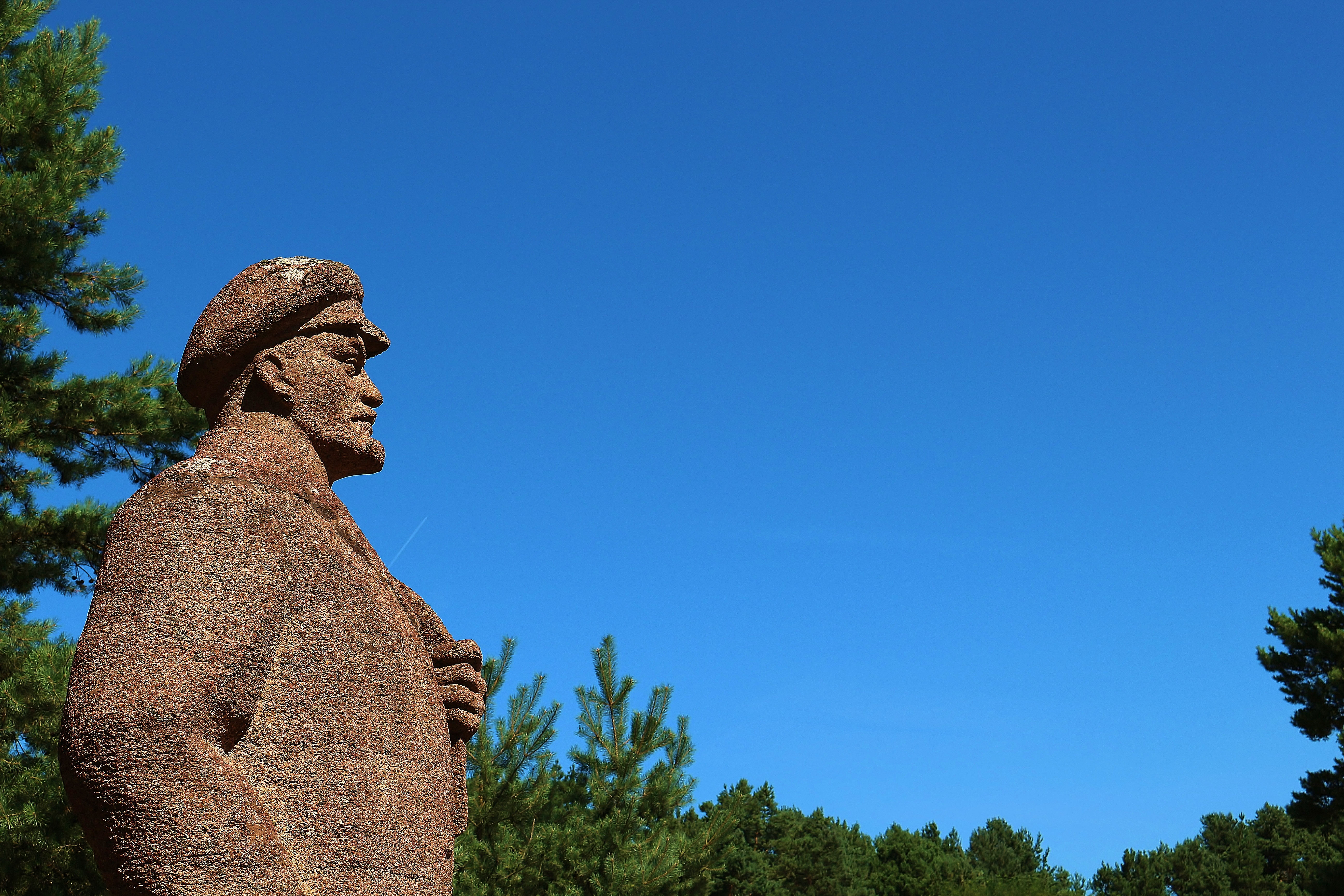
Though the style of Soviet Realism, which dominates amongst the public monuments with politic relevance in the entire Eastern Block, was not precisely known for its variety, it’s quite surprising, in how many different forms it was able to represent Lenin. For instance in the 3 meters statue of Eberswalde made of red granite, the role of strong statesman isn’t specially emphasized, being Lenin rather presented as a dreamy thinker: With one hand in the pocket and the other grabbing his coat collar, his glance gets lost in the distance. He is wearing the Swedish fisherman cap, which he bought in 1917 in Stockholm, on his way back to Russia after many years of exile in Central Europe, and looks a little bit fatter than usual. If it wasn’t for the unmistakable facial features, one could think to be standing in front of the figure of a Scandinavian Fisherman, looking into the infinite ocean…
Red carnations for Lenin
Since the 19th century, red carnations have been considered a symbol of the international labor movement: Back then they were carried out by the participants of illegal meetings in Germany and France. During the period of the Cold War these flowers would become a distinctive mark of Socialist ideology in the Soviet Union and Eastern Europe. To celebrate special holidays, people would put them down – and actually still do nowadays – at the grave of soldiers fallen in war or in front of monuments dedicated to the adored state-idols. In Nohra, on a sunny spring day, we found red carnation lying in front of the statue of Lenin. They were not real, but plastic-flowers, maybe because they are cheaper and last longer. Weiterlesen
Thorns
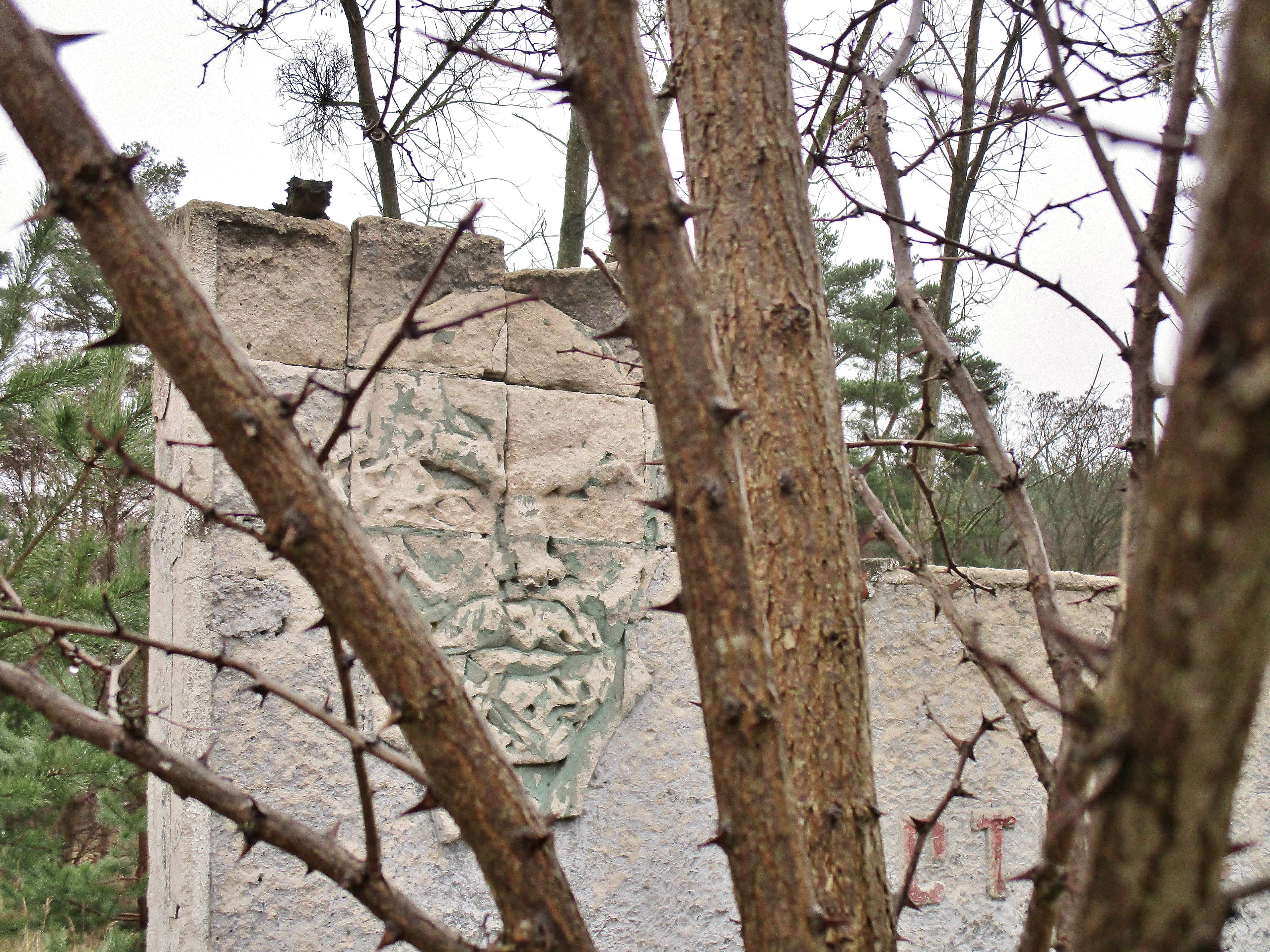
Next to the national road B96 before entering Fürstenberg you can find two big relief walls, a free accessible remnant from the Soviet presence in Germany. It is an historical testimony to see, read and touch, that shows the glorious portrait of the Red Army as the big winner of World War II and also the ideal Communist projection for the post-war period. The monument is abandoned and falling apart, what in turn reflects the current dealing with the East-German past: Nobody wants to know anything about the Soviet heroism, not even about the liberation of Berlin from National Socialism accomplished by the Red Army in 1945. At least this memorial wasn’t demolished, so that even nowadays historians, strollers and curious persons still have the chance to get delighted by this relic. Weiterlesen
White Lenin
A Berlin tourist guide once told me, that the first place he visited with his groups from the USA was the Soviet War Memorial: “So they can see, that in Berlin they can to expect the unexpectable!” In fact, from a Western perspective the monument is quite disconcerting or even a little bit bizarre: The nationalistic pathos and the communist symbolism create a flourishing tribute to Soviet patriotism, which many would not expect to find in the heart of Europe in the 21th Century. Weiterlesen
Lenin stays
ENGLISH
While many of the last monuments dedicated to Lenin in Germany are in danger of being demolished or crumbling away in front of an abandoned barrack, the Lenin in Riesa has guaranteed a safe and well-tended existence. Since 1991, when the figure was moved into the little park next to some Soviet war graves, there is no longer any threat. It can stay there as heroic sentry and enjoy the sun and fresh air. Analyzing the statue, one could think, that behind the iron expression there is a light smile on Lenin’s face: Probably he is just glad about the ironic and happy end of the story of his overhasty removal from the former Lenin Square.
WeiterlesenWhat is to be done?
ENGLISH
The view over the impressive statue of Lenin in the district of Großer Dreesch in the city of Schwerin looks like a postcard from the past. With his hands in the pockets and his venturous look, the communist idol stands in the middle of an unvaried landscape of Soviet architecture and long parallel avenues. Weiterlesen