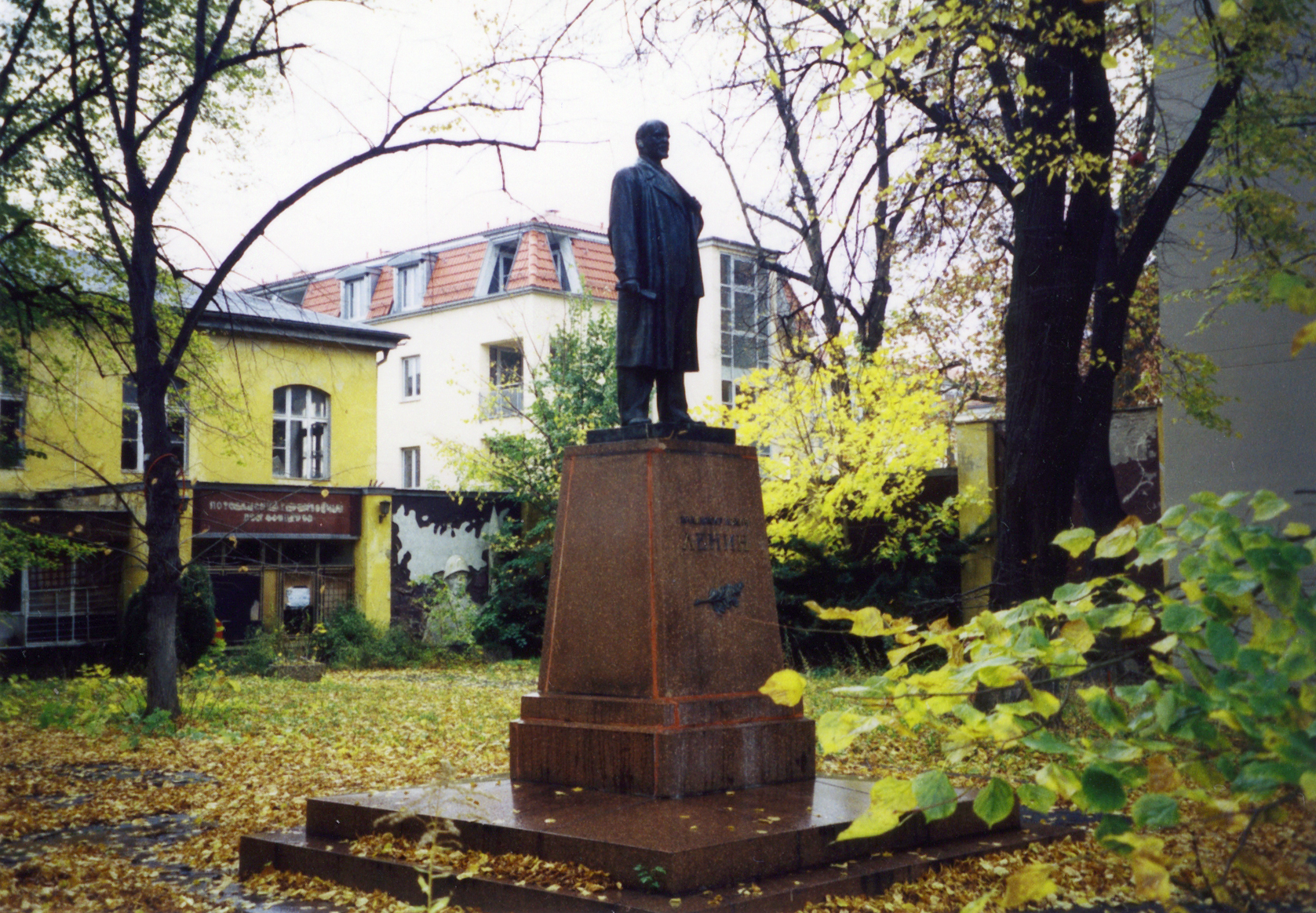
A statue, which is under monument protection, but disappears without a trace. An old and forgotten bust, which suddenly is standing at the entrance of the Volkspark. Lenin’s existence in Potsdam is a succession of mysterious incidents and even journalists, politicians and public authorities lose track of it. Weiterlesen
Schlagwort: GDR
At the border
In April 2016 a bust of Lenin was erected only a few meters from the border between Germany and Poland. During World War II, this sculpture had been stolen by the German army in the Soviet Union and sent to Küstrin-Kietz, in order to be destroyed and reused as a raw material for the arms industry. But two workers of the scrapping facility decided to hide it, saving it from the imminent smelting. Weiterlesen
Damnatio memoriae (ENG)
The abandoned military area of Wittstock has turned into a ghost town. Entire apartment buildings, schools, office-blocks and hangars are falling apart. In front of the former cultural center we find an image, which is rich in contrasts: Lenin is standing there with his typical statesmanlike pose, but he is mutilated and completely covered with lichen. It was not possible to get more information about this act of vandalism, but the view of this half-destroyed statue seems like an exemplary representation of the neglect of the East-German monumental landscape. Weiterlesen
In the shadow of the Berlin Wall
The relaxed Lenin
Near the Saxon city of Riesa, where one of the last statues of Lenin is still standing in a public square, there is another, rather unknown sculpture of the Soviet revolutionary. It’s standing in the restricted area of the former military area of Zeithain, which is now open to public. Weiterlesen
Lenin in Forst Zinna (ENG)
Between Luckenwalde and Jüterbog we find the nature reserve of Forst Zinna-Jüterbog-Kellberg, where one of the darkest pages in the history of the Group of Soviet Forces in Germany was written. Back in the 19th century, the German army built a military training area, which was expanded by the Wehrmacht during World War II and taken over by the Red Army after the Nazi’s capitulation. This military area included a driving school for tanks. Weiterlesen
Lenin‘s head
On April 29th 2016 the exhibition „Unveiled – Berlin and its monuments” was solemnly inaugurated at Zitadelle Spandau. Its main exhibit is a two-meter large head of Lenin with a weight of 3,5 tonnes. It is made of red granite and used to be part of East Germany’s biggest Lenin-monument. After the reunification, the statue was banished from Berlin, dismantled and buried in a forest nearby. This head was especially dug up for this exhibition and attracted a lot of popular and media attention. The explanation for this high interest was not only the figure of Lenin itself, but especially the amazing history of this monument, which could serve as the script for a Hollywood-movie. Weiterlesen
In the former Soviet Embassy
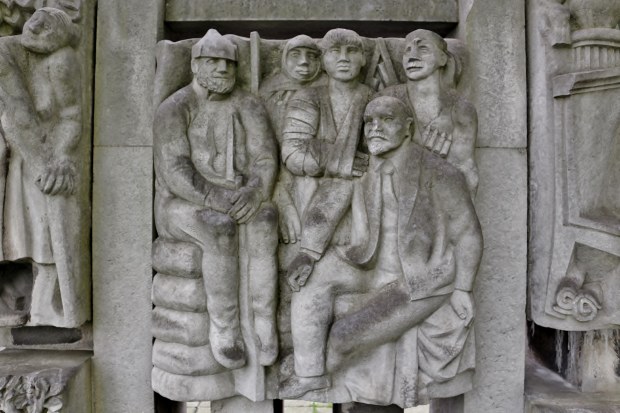
During the period of the German Democratic Republic, the former Soviet Embassy in Berlin erected two Lenin-monuments in its premises: a white Lenin-bust in the front garden of the embassy and a copper relief on the exterior wall of the swimming bath, located behind the main building. After the GDR’s collapse, the two monuments had different destinies. Weiterlesen
At the abandoned military hospital
Hidden beyond a green curtain of trees and wild growing shrubberies, we can still find the abandoned complex of the former military hospital in Jüterbog. After the Soviets left it in 1993 after using it for 48 years, the buildings were emptied by German authorities and abandoned. Nowadays and after so many years of decay, the main building looks like a location for a horror movie: long corridors with peeled walls, collapsed ceilings, broken windows and two completely rotten operation rooms with a chair and a bed. Weiterlesen
Visiting Karl Marx
In June 1990 the city of Chemnitz, which had been renamed to Karl-Marx-Stadt in the 50s, got back its former name. Nevertheless, Karl Marx is still nowadays one of the biggest icons in the city’s landscape, especially because of the 7,10 meter high bust standing in front of a giant panel where translations into different languages of the famous sentence from the Communist Manifest: “Workers of the world, unite!” are placed. It is the second biggest bust in the world, only surpassed by the sculpture of Lenin’s head in the Russian city of Ulan-Ude. Besides this, in Chemnitz there are still some other Socialist monuments to see: Walking through the streets, one can meet Engels, Thälmann, German antifascist soldiers, who fought in the Spanish Civil War, and also Lenin. Weiterlesen