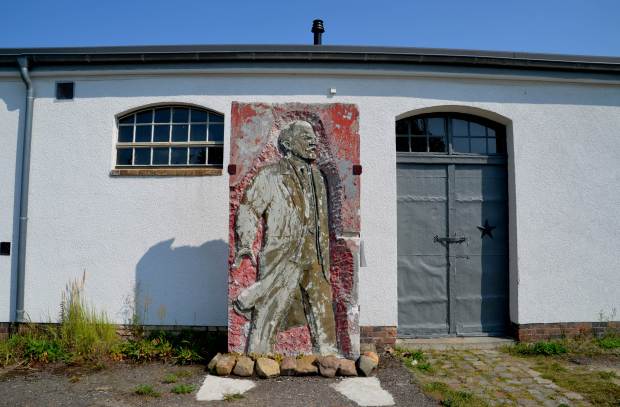
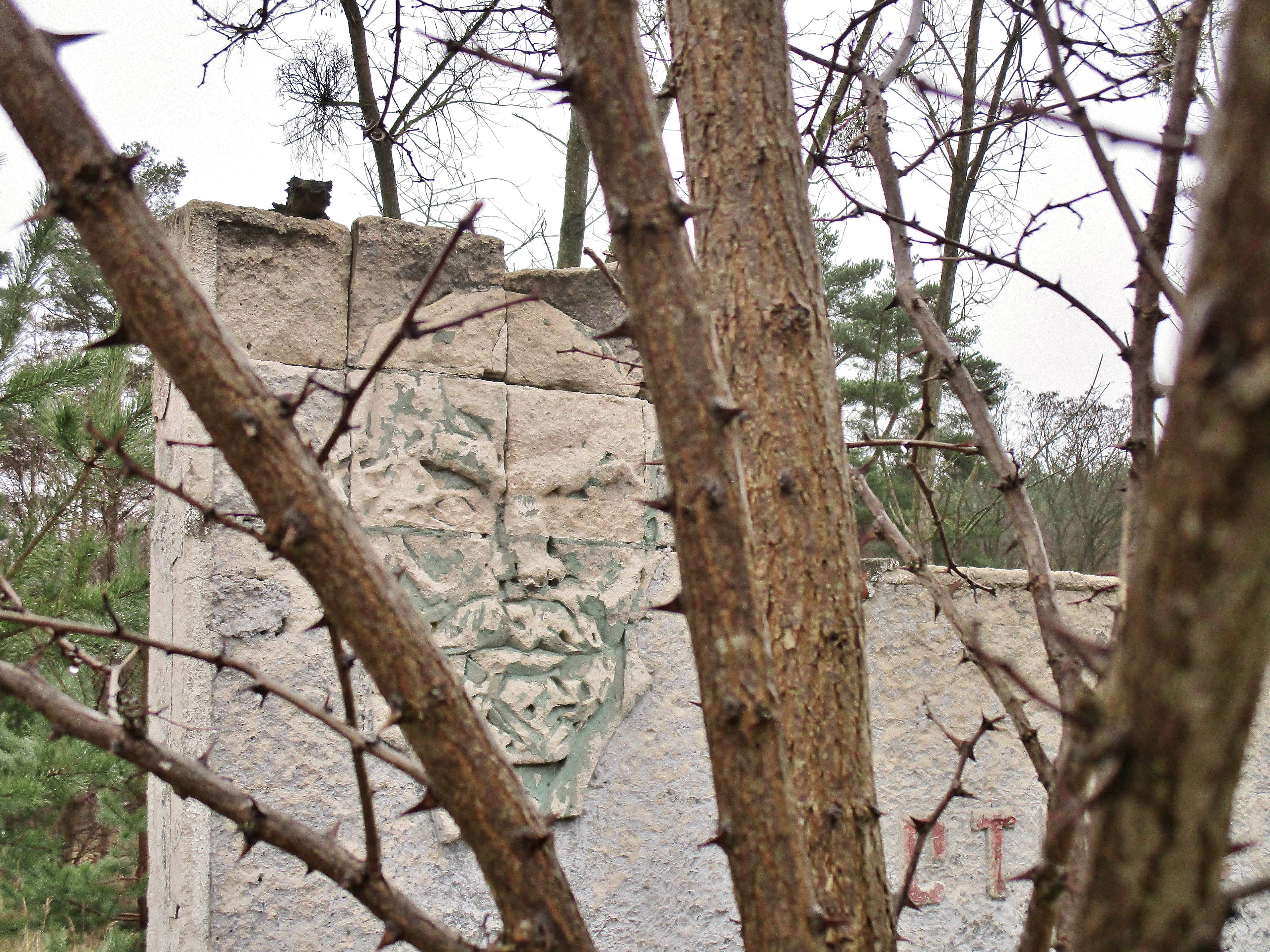
Once hundreds of neat soldiers of the Soviet Army marched here past the tribune of honour and the two freshly painted murals. Today, however, this is only a pale memory of times past. As pale as the colour of the two Soviet steles: One shows a Red Army soldier, the other Lenin. Although the Soviet revolutionary leader has been abandoned for almost 30 years, his stony gaze and charisma still remain on the former parade trail. Weiterlesen
Schlagwort: Abandoned
Urbex restoration of a Lenin mural
While imperial and even colonial or Nazi monuments can easily be put under monumental protection in Germany because of their historical value, after the fall of the Berlin Wall attempts were made to demolish all representations of Lenin. Some of them survived the iconoclasm in former military complexes of the Soviet Army. Now they must resist abandonment and vandalism. Weiterlesen
Vogelsang’s Lenin saved from demolition

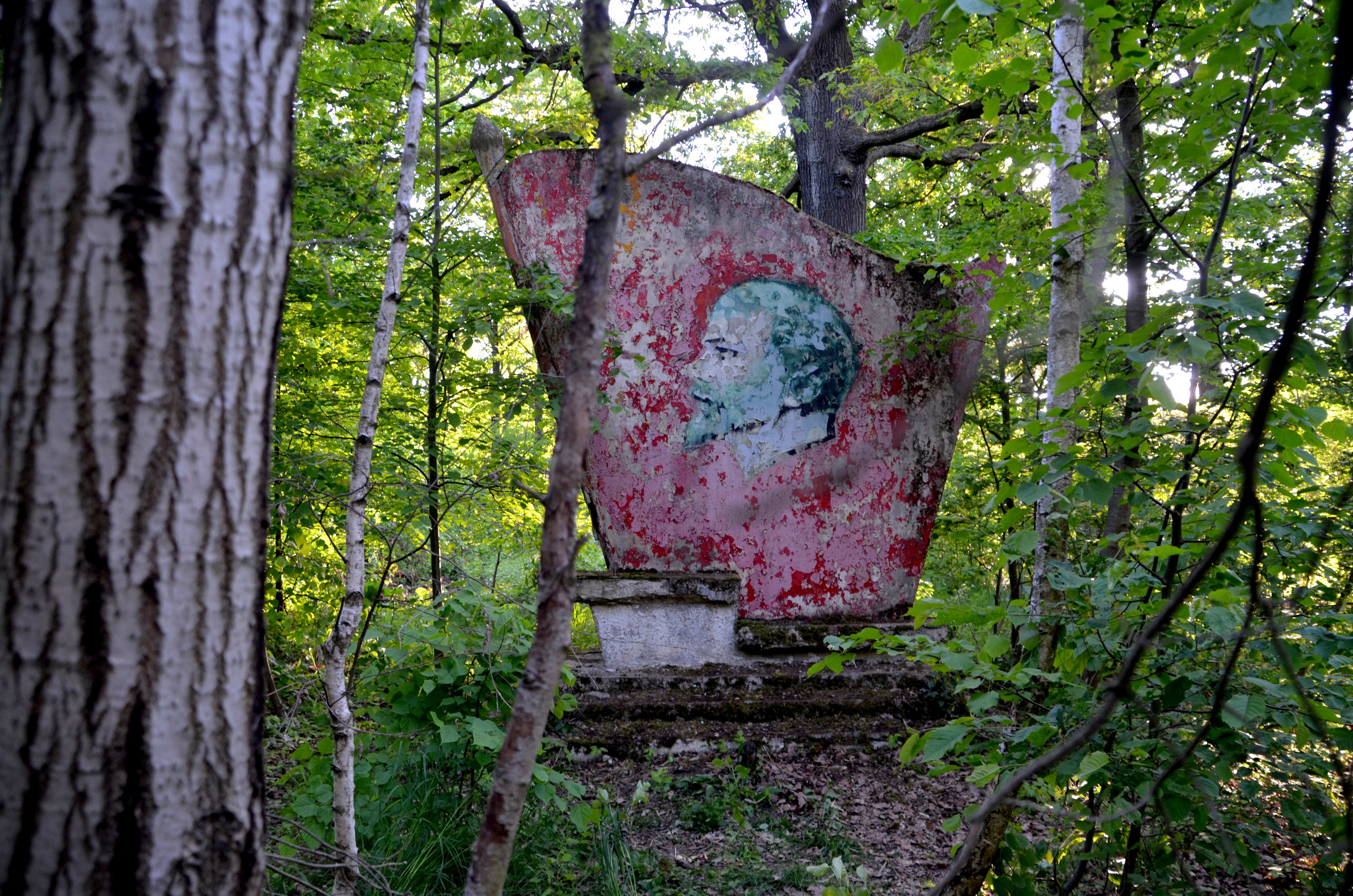
After the Red Army left its base in Vogelsang, Brandenburg, the abandoned barracks turned into a popular destination for photographers and adventurous tourists. The main attraction was the large mural with a Lenin relief between the old café and the officers‘ house. However, a few years ago, following the decision to renaturalize the area, the demolition of the entire military complex began, which also endangered the Lenin Monument. But finally the monument to the Communist revolutionary was saved in spring of 2017 and taken to Wünsdorf, being placed in front of a museum. Weiterlesen
Damnatio memoriae (ENG)
The abandoned military area of Wittstock has turned into a ghost town. Entire apartment buildings, schools, office-blocks and hangars are falling apart. In front of the former cultural center we find an image, which is rich in contrasts: Lenin is standing there with his typical statesmanlike pose, but he is mutilated and completely covered with lichen. It was not possible to get more information about this act of vandalism, but the view of this half-destroyed statue seems like an exemplary representation of the neglect of the East-German monumental landscape. Weiterlesen
The relaxed Lenin
Near the Saxon city of Riesa, where one of the last statues of Lenin is still standing in a public square, there is another, rather unknown sculpture of the Soviet revolutionary. It’s standing in the restricted area of the former military area of Zeithain, which is now open to public. Weiterlesen
Lenin in Forst Zinna (ENG)
Between Luckenwalde and Jüterbog we find the nature reserve of Forst Zinna-Jüterbog-Kellberg, where one of the darkest pages in the history of the Group of Soviet Forces in Germany was written. Back in the 19th century, the German army built a military training area, which was expanded by the Wehrmacht during World War II and taken over by the Red Army after the Nazi’s capitulation. This military area included a driving school for tanks. Weiterlesen
At the abandoned military hospital
Hidden beyond a green curtain of trees and wild growing shrubberies, we can still find the abandoned complex of the former military hospital in Jüterbog. After the Soviets left it in 1993 after using it for 48 years, the buildings were emptied by German authorities and abandoned. Nowadays and after so many years of decay, the main building looks like a location for a horror movie: long corridors with peeled walls, collapsed ceilings, broken windows and two completely rotten operation rooms with a chair and a bed. Weiterlesen
Lenin‘s slogan at the former airfield
During the GDR, Lenin, Marx and Engels were an omnipresent triumvirate of Socialism, but nowadays it has become really difficult to find them together on German soil. The former airfield in Köthen is one of those few exceptions: At the exterior wall of a big pavilion you can still find their image as simple two-color wall-paintings. Weiterlesen
Red carnations for Lenin
Since the 19th century, red carnations have been considered a symbol of the international labor movement: Back then they were carried out by the participants of illegal meetings in Germany and France. During the period of the Cold War these flowers would become a distinctive mark of Socialist ideology in the Soviet Union and Eastern Europe. To celebrate special holidays, people would put them down – and actually still do nowadays – at the grave of soldiers fallen in war or in front of monuments dedicated to the adored state-idols. In Nohra, on a sunny spring day, we found red carnation lying in front of the statue of Lenin. They were not real, but plastic-flowers, maybe because they are cheaper and last longer. Weiterlesen
Thorns
Next to the national road B96 before entering Fürstenberg you can find two big relief walls, a free accessible remnant from the Soviet presence in Germany. It is an historical testimony to see, read and touch, that shows the glorious portrait of the Red Army as the big winner of World War II and also the ideal Communist projection for the post-war period. The monument is abandoned and falling apart, what in turn reflects the current dealing with the East-German past: Nobody wants to know anything about the Soviet heroism, not even about the liberation of Berlin from National Socialism accomplished by the Red Army in 1945. At least this memorial wasn’t demolished, so that even nowadays historians, strollers and curious persons still have the chance to get delighted by this relic. Weiterlesen