During the GDR, Lenin, Marx and Engels were an omnipresent triumvirate of Socialism, but nowadays it has become really difficult to find them together on German soil. The former airfield in Köthen is one of those few exceptions: At the exterior wall of a big pavilion you can still find their image as simple two-color wall-paintings. Weiterlesen
Schlagwort: Barracks
In front of the food-stand
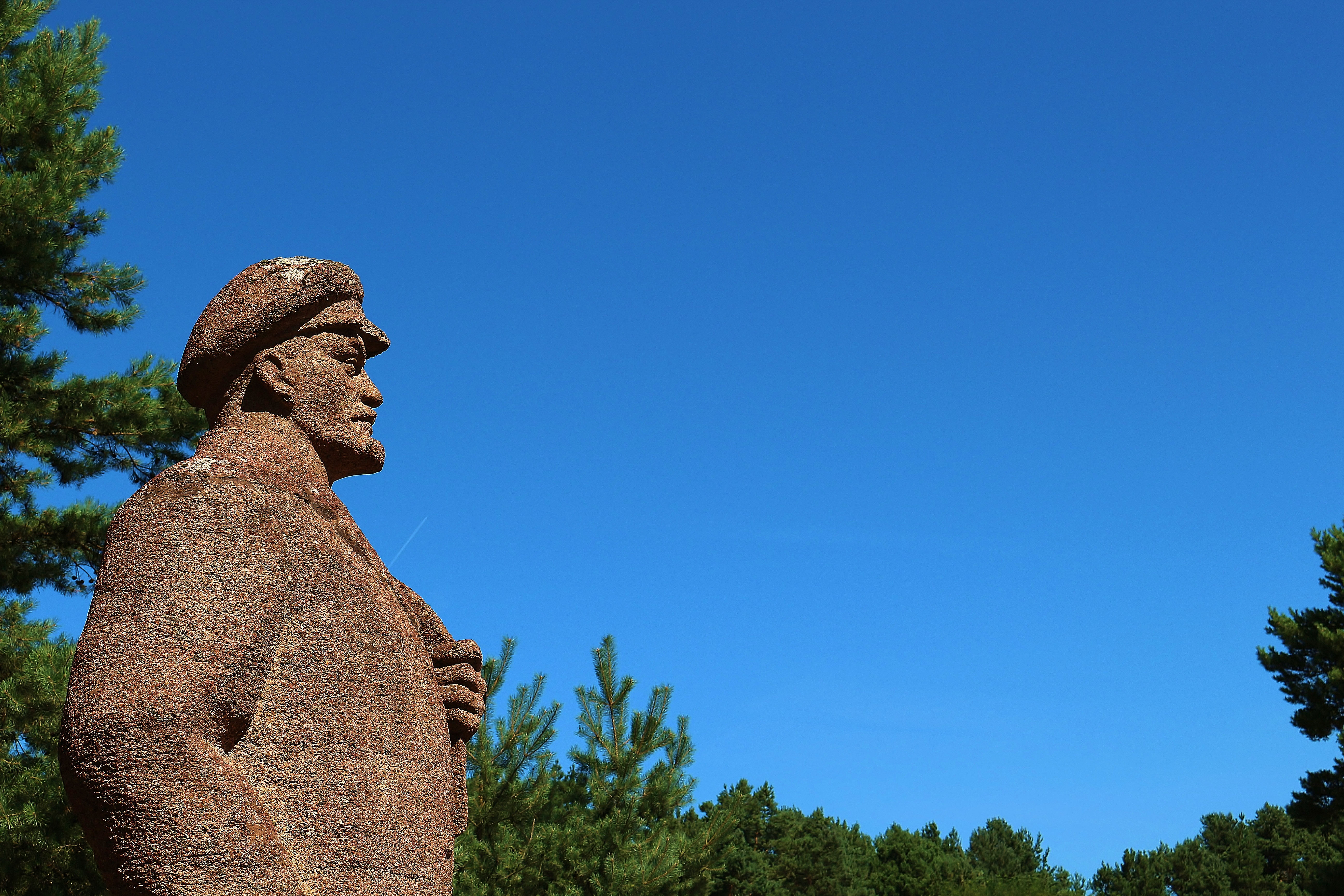
Though the style of Soviet Realism, which dominates amongst the public monuments with politic relevance in the entire Eastern Block, was not precisely known for its variety, it’s quite surprising, in how many different forms it was able to represent Lenin. For instance in the 3 meters statue of Eberswalde made of red granite, the role of strong statesman isn’t specially emphasized, being Lenin rather presented as a dreamy thinker: With one hand in the pocket and the other grabbing his coat collar, his glance gets lost in the distance. He is wearing the Swedish fisherman cap, which he bought in 1917 in Stockholm, on his way back to Russia after many years of exile in Central Europe, and looks a little bit fatter than usual. If it wasn’t for the unmistakable facial features, one could think to be standing in front of the figure of a Scandinavian Fisherman, looking into the infinite ocean…
The Tank Division in Bernau
ENGLISH
Now that he was relegated from the central spots of the capital, Lenin has got to hang around in remote ruins. In Bernau there are two parcels with big building blocks, which were the headquarter of the Heeresbekleidungsamts – something like a national clothing agency – during the Third Reich. After the war, the Red Army took over the place. The 90. Armoured Division was the last group to use the installations, before they were abandoned in the year of 1993: Where once was a direct train track, in order to deliver asap the new fancy uniforms or the most modern weapons, trees and bushes are growing now completely unwound. And in the buildings, in which generals were discussing the posible development of a third world war, now prevails the decay and a grave silence, which is only interrupted by some distant footsteps and you ask yourself if it’s only the echo of your own ones or maybe the ones of a soldier, which was left behind… Weiterlesen
Lenin in death row
ENGLISH
Vogelsang, the name sounds very poetic and the landscape around this little village in the region of Oberhavel is quite idyllic. The forest with its tall trees could be part of a fairy tale and actually it conceals some hidden surprises. If you walk from Vogelsang heading north you will get to the ruins of a desolate and decaying military area. During the times of the Democratic Republic of Germany it belonged to the soviet army and there were up to 15.000 soldiers and civilians living in these buildings. During the climax of Cold War nuclear missiles were kept in Vogelsang, in order to be able to attack Paris and London, if the situation would get serious. After using this area for almost 40 years, the soviet army abandoned it in 1994. For two decades it served as exotic, alternative and – because of the rest of ammunition that was spread all around the area – totally forbidden – therefor more demanded tourist attraction. Weiterlesen
In abandoned Little-Moscow
ENGLISH
In every corner of the little town of Wünsdorf you can still find traces of the Soviet occupation. Here was located the biggest military area of the Red Army outside the Soviet Union: 590 hectares with 1000 buildings were surrounded by a wall of concrete, and completely inaccessible to the German population. More than 50 000 Soviet soldiers and civilians were living here and there were daily trains directly from the so called “Russian Station” to Moscow. But actually the military use of this territory began much earlier: In the beginning of the 20th century an infantry school was built here. During the III. Reich it was expanded by the Wehrmacht, who installed many important services here such as the intelligence headquarters. In 1945 the Red Army conquered this complex and a few months later the high command of the Soviet Forces in Germany moved to Wünsdorf and continued to expand the military area so that outside the large wall there were still 6.200 hectares for military training being used by the occupying forces. During the times of the GDR, Wünsdorf used to be called the “Little Moscow“. Weiterlesen